Obama v. Hilary

How fast was Hilary’s fall? Just a few weeks ago, she gave a hint of emotion in New Hampshire and grabbed the title of front-runner. Now press has all but declared Obama the nominee. John McCain appeared to agree too. He and Hilary are now allies: sharing the same enemy.

Since John F. Kennedy, Americans chose character over everything else in presidential elections. They watch the candidates’ faces and feel their voices. They look for not charisma, not experience, but someone who cares and is trustworthy. I talked to a young person in San Francisco bay area recently. She is a dreamy, idealistic, Berkeley democrat. I was surprised that she does not identify with a same-gender candidate and would vote for a black male. Slightly offended, she insisted her choice was based on issues. But not so, as I drilled down. Obama does not quite agree on her on several issues. In fact, on those issues she cares about, Obama and Hilary are pretty similar in their stances. Finally, she admitted, “I just don’t like Hilary.” I did not let go, “But what about her that you don’t like?”

“The lack of compentency and experience,” she said. “Can be remedied with good staff. I look at Hilary and cannot trust her.” “Do you trust McCain then?” I asked. “Yes,” she smiled wickedly. “But let’s not go there.”

Hilary is a high-caliber executive who can make tough decisions. Obama is poetic. If democrats are supposed to be dreamy and idealistic, I guess Mrs. Clinton needs to show a bit more herself to win.

Posted in Peek into my mind | Leave a comment

Tokyo

I left China on the Chinese New Year’s Eve when a big part of the country was fighting the worst snow storm in 50 years. Tokyo should be several degrees warmer than Beijing, so I was relative at ease.
Snow started faling when I walked out of the airport. The girl who guided me to the driver was not pleased at all. “Yuki ga futte,” she complained. Funny that snow fell again, strong and blowing, the night I toured Ginza. Guess I brought a bit of China to Tokyo.

Beijing literally means “the capital at North.” It has been the capital of Chinese since the Yuan dynastry, for about 800 years now. In Chinese history, it is really a young capital. Xi’An, literally means “Peace on the West” was the 1st capital when China became China about 2200 years ago. Nanking, “capital at South,” was the capital of China before Beijing for a few hundred years too. Tokyo, now the capital of Japan, actually means “capital at East.” I guess this visit completes my collection of capitals.

If Tokyo is representative of Japan, then what a polite country it is. Most Chinese are still nursing the wounds Japanese inflicted on them during World War II. China fought 8 years against Japan during World War II — 4 more than most other countries. Japan brutalized Nanking in the most savaged and inhumane manner. To many Chinese, Japanese are cruel cold-blooded colonizers.

And those Chinese will be wrong. Human beings are really very similar in their basic nature. There are histories and cultures that shape social protocols. There are languages that separate communications. Once you cross those differences, you find decency and kindness underneath every races, countries, or tribes.

Unlike most places in China, there are no cell phone intrusions in Tokyo. During the entire 3 days, I heard not one single cell phone ring and never had the opportunity to overhear someone’s conversation. When they must talk in public, they covered their mouths and used low and hushed voices. On subways, most people wear a pair of earphones, read, or manipulate their cell phones in silience. One passenger next to me was watching live TV on his cell phones. Others appeared to be texting or emailing. Whatever they did, there was no sound. What a bliss coming from Beijing that is such an opposite.

Ueno Park (上野公園)
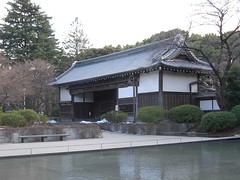
This is a big park at the center of a brisk neighborhood. Our destination was Tokyo National Museum that exhibits Courtly Millennium – Konoe Family (近衞家) Collection . I don’t know Japanese history well. This family seems to play important political roles for a few hundred years in Japan’s history. The collection include many historical documents regarding political appointments and ceremonial processions. There are lots of arts and artifacts that are more interesting to me.

The park itself is lovely and encompassed three museums, a shrine, a Buddhism temple, a large Buddha scrupture, and several restaurants. We had lunch in one of them. The service was thrift and thorough and the foods were delicious.

Roppongi (六本木)

Roppongi has been the traditional embassy area of Tokyo. As such, it has always teemed with upscale and westernized entertainments. There is a direct subway path from my hotel, so getting to there is quite easy. We had a lovely dinner there and went again to visit the newly open Tokyo Midtown — a big city block of high-rise buildings that houses stores, restaurants, high-end hotels, galleries, and a museum. It is easily a full day’s activities in it. We shopped, ate, and visited Santory Museum of Art that was exhibiting Toulouse-Lautrec et la vie parisienne from Louvre.

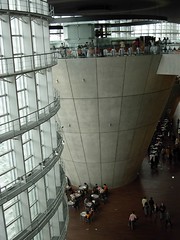
Right next to Tokyo Midtown is the new National Art Center of Tokyo. This is a stunning architectural work that reminds me a lot of Beijing’s Capital Museum. The special exhibit of Yokoyama Taikan (横山大観), 50 Years on is quite enjoyable. This Japanese artist enjoyed a long and prolific life. His paintings were impressive and moving. I wanted to buy several replicas but ended up with some postcards, considering my luggage capacity.

Ginza (銀座)
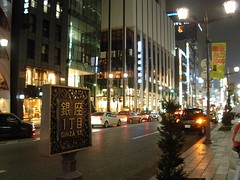
This is the shopping haven of Tokyo Metropolitan just like Fifth Avenue of New York, WangFuJing of Beijing, and Union Square of San Francisco. It is always packed with tourists and shoppers. There are *two* Tiffany’s store here. The Harry Winston’s front door stood a large and intimidating guy to make sure no casual shoppers will ever walk in. There are so many restaurants of so many kinds of cuisines to satisfy the most discriminating foodies. Of course, several credit cards of high limits are a prerequisite to enjoy Ginza.

We were just strolling and experiencing it. The timely snow/rain cut the tour short and probably save us several hefty credit card bills.

Shijuku (新宿)

This is the governmental center of Tokyo, where city hall and muni-parliament are. Large department stores, shops, and restaurants surrounds the subway station. There are buildings devoted to electronic goods: gadges, TV, stereoes, computers, etc. There is this maze of underground structures to meet all your shopping and consumption needs without exposed to the elements outside.

Metro, Subways, and Trains
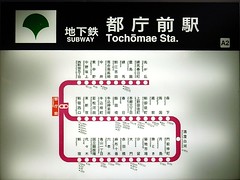
The subway system reaches every corner of this metropolitan. I can pretty much reach wherever with one transfer and about 20 minutes’ walk. That transfer, however, can be nearly half-a-mile’s navigation through a maze of esclators and pass-ways. There are big maps displayed everywhere in the subway station or street corners. That aids this city of walkers, and anyone who can read Kanji and basic Japanese. I feel safe and comfortable with a subway map and a simple tour guide in this city.

Restaurants

Every restaurants were good. Several are worth mentioning.

MatsuRokuKu (御曹司 松六家) is a tiny one in Roppongi. The hallway is narrow to allow only a skinny person. There are 4 or 5 tatami rooms each house 4 to 5 people. Sake flew and bite size dishes came endlessly. Each one was so beautifully arranged and delicious too. The server will explain the dish in Japanese and our host will try to translate, with difficulties. The mistery enhanced the fun and sake clearly contributed too.

Hana MiChou 花・味兆(はな・みちょう) is a slightly larger one in Aoyama (青山). There are 3 or so tatami rooms enough for 6 to 8 people. There is also a mess hall with western tables and chairs for about 20 seats. Again, the menu is largely pre-fixed, just the way we wanted. This time, our host chose Shocho, a stronger drink customarily diluted with ice water. We are now used to the parade of beautiful and small dishes. This one out-did MatsuRokuKu in style and elaboration. The climax was this hot-pot heated by miniture propane. The meal lasted until almost mid-night. Both foods and company were memorable.

DinnerDinnerDinnerDinner
DinnerDinner


Brasserie Paul Bocuse Le Musée is a high-end French restaurant inside of Roppongi’s National Art Center. People will wait for the meseum to open to reserve a table for lunch or dinner. We received a placard that told us to come back in an hour. At about 2pm, we got a table for two. The ambience was artsy, sophisticated, and comfy. The foods were pleasant and enjoyable. The service was friendly and warm. Nice foods for the soul and the body in one sitting, why didn’t other people think of this before?

Tokyo is an expensive city. Obstensibly, there is no sign of the decade of economic hard time. Swarms of people filled stores, museums, restaurants, and all those consumption places. The prices are at least on-par with US and sometimes quite a bit higher. (Subway fares across town cost about 6 to 8 dollars. StarBucks Grande Drip is $3.5. A sit-down quick-order “diner” style lunch for two is about $30. I saw a cateloupe at over $200! Yes, two hundred dollars.)

Japanese that I met are proper, polite, perseverant, disciplined, and detail attentive. These are wonderful quality for modern industrial successes and they proved that. There are many theories on this decade of tough time. Most attributed to the post-World War II keiretsu system, the aging population, and the life-time employment social contract. It seems clear to most economists that this society must change to fend off the surging China. Few of them agreed on how. The debate, or indecision, is wasting away the precious time.
Posted in Tour guides | 3 Comments

Floating Point Arithmetic

I started my software engineer career constructing an Mechanical CAD software. One day, my tangential algorithm yielded a line that does not even touch the curve it is supposed to be tangent to. The graphics on the screen is off by several pixels. I was miffed. Checked and re-checked. It was not a graphics problem, my algorithm was correct, and the implementation was not buggy. That stumped me for a few days until I learned about floating point round-off errors. With just a few lines of code changed, the line snapped neatly onto the curve. That was the 1st time I learned the difference between real numbers and computerized floating point numbers.

Then I worked for Sun and met this guy (forgot his name) who was on the IEEE standard committee. All he talked about are Fortran, Inf, NaN, floating point exceptions, and those things I had no clue about. Good thing I was young and he was patient.

In pretty much all computers these days, floating point arithmetic are not precise. If a programmer is not careful, a surprising large error can happen from simple operations. Every programmer should really read the famous paper: What Every Computer Scientist Should Know About Floating-Point Arithmetic. In addition to floating point rounding off, novice programmers frequently trip on integer overflow (or underflow). Simply put, if you put two integers together and the sum is greater than what a computer can hold, it simply throws away the excessive bits and leave you with a result that can be very surprising. (Try adding 2,000,000,000 and another 2,000,000,000 to an “int32” typed integer variable. Guess what’s the answer before running the program.)

Posted in Peek into my mind | Leave a comment

Ho Chi Minh City

First time to VietNam, and obviously, Ho Chi Minh City.

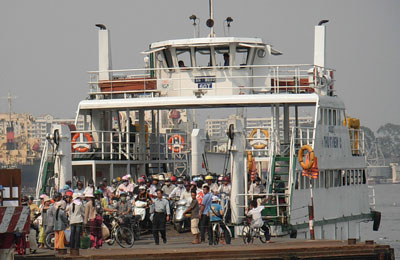
The airport is modern, clean, and spacious. The custom was courteous and speedy. When we entered the city, seas of motorcycles swallowed the car that I was in. Whenever the car stopped, motorcycles or scooters will surround it and fill spaces between cars like water poured into a porous object. I thought of China’s seas of bicycles just a few years ago. Beijing has basically outlawed motorcycles and replaced bicycles, rapidly, with electrical bicycles.

This largest city of VietNam of about 6.5 millions people is hot and humid. With snowy and frigid (-4C or 25F) Beijing vivid on my skin, I felt strange in T-shirt and shorts walking out of the hotel. Beijing quickly melted away in a light sweat.

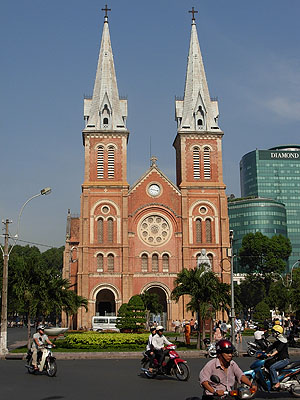
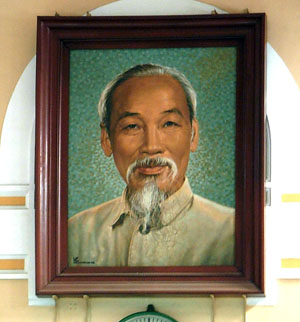
The Central Postal Office has an impressive interior sporting the painting of Mr. Ho Chi Minh himself, Chairman Mao style. Next to the postoffice is the Notre Dame Cathedral: a traditional Catholic church with two high towers. It is an active church with all the standard functions. Traffic-wise, the church is an island surrounding by roads all around it. I need to negotiate waves of motorcycles to cross the street. I wonder how does it handle the Sunday worshipers?

The Ben Thanh market occupies pretty much an entire city block. It is covered, packed, and relies only on natural air flow to cool the interior. This market serves both local and tourists. There are live seafood, fresh meats, produces, and everything a large supermarket will stock. In addition, there are booths packed to the density of allowing only a single person to squeeze through. Shoes and sandals can fill the entire booth. Sun glasses appears to be a very popular item. I bought one for 100k VietNam Dongs. The exchange rate is roughly 16,000 VND to one dollar. You must be good at arithmetic to live in VietNam.


More pictures on .

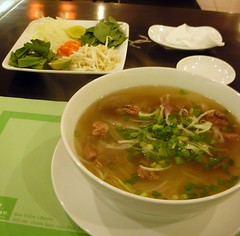
Can’t really visit VietNam without having a bowl of Phõ. Right? I am glad to report the VietNamese version tastes exactly the same as California, with just slightly different condiments. Other VietNamese foods I sampled kind of sweet. Yet I saw no obese people anywhere. Actually, no one was even mildly over-weigh. You can tell foreigners (Asian descent like myself) mostly instantaneously by their sizes.

Cannot really recommend Sheraton. For $260 a night (including Internet and breakfast), I expect royal treatments and got normal hoteling. Then again, I have paid much more for much less hotel in India. Supply and demand have funny way to make a consumer feel gouged all the time.

VietNam, sampled over a few days at a single city, seems like a thriving country with eyes fixed on the fast growth pattern of China and India. The formula seems simple: open relentlessly, don’t be too democratic too fast, focus on infra-structure and education, leap-frog on IT structure, teach people English. I have known many VietNamese. They are all smart, hardworking, and patient to harvest later. I came to country and see similar characteristics. I believe this country is taking off. Investors, take heed.

Posted in Tour guides | Leave a comment

Year of the Rat

This will be my 3rd installation of Chinese New Year blog. There had been sad departures this year in Beijing. We have seen many friends leaving their posts, often for something better or bigger. This is a vibrant and fast-paced city. People come and go. Many left their imprints on our hearts.

I wrote two years ago that

Years are numbered in cycles of 60. You can think a Chinese “century” is 60 years. Instead of numbers, Chinese name these 60 with two counters: one in the cycle of 10 and the other 12. The former is called the “heavenly” counter (天干, TianGan) and the latter “earthly” (地支, DiZhi). The earthly counter is actually 12 animals.

Similarly, I wrote last year that.

Chinese years are counted with two cyclical counters, one has ten symbols and the other 12. Together, they make up cycles of 60. In a way, a Chinese century is 60 years. Each counter is characteristically categorized into one of the 5 elements — metal, wood, water, fire, and earth — that make up everything in the universe. These 5 elements are assigned to the first 5 planets of the solar system, respectively Venus, Jupiter, Mercury, Mars, and Saturn.

Not only each counter has an element, it is either of Yin or Yang. This year is the 5th on the heavenly counter and 1st in earthly: 25th in the cycle or the year of 戊子 (WuZi). In Chinese numerology, odd numbers are Yang and even numbers Yin. The 5th heavenly counter, 戊, is of the earth element. Adding all these together, we have a earthy and masculine (Yang) rat coming.

This reveals a rarely known factoid about the earthly counters: why are those 12 animals chosen? It turns out the sequence of these 12 animals are alternating in Yang and Yin. Those with odd numbers of toes are Yang animals and those even Yin. The Yin or Yang of heavenly and earthly elements always matches: Yin with Yin and Yang with Yang. The world is in harmony and all is good, except for rats.

Rats have an unique Yin Yang quality. They have 4 toes in their front paws and 5 in the rear; they are both Yin and Yang! For this reason, rat designates the mid-night hour, the time in between Yin and Yang. This makes many Chinese not sure about rats: ghosty, sketchy, shifty. On the other hand, rats reproduce quickly and are impossible to exterminate: proliferating, energetic, diligent, and tenacious. There are advantages to be in the year of the rat.

第三次写新年。今年有许多别离,朋友伤感的离京告别,追求美梦。绚丽快步的北京, 人来人走,在心中留下雪泥鸿爪。

两年前写了天干地支及60年甲子轮回。去年加写了五行,解释丁亥年是火猪,不是金猪。其实天干中不但有五行,还有阴阳:奇数阳,偶数阴。戊属土。所以戊子年是阳性土鼠。

这倒提出了常见的问题:12生肖是怎么来的? 其实很简单,奇数趾的为阳,偶数为阴,阴阳交替。 阴的天干永远对阴的地支,阳永远对阳,只有鼠年除外。 鼠前脚4趾,后脚5趾,又阴又阳。 所以它是午夜的时段,一个阴阳交替的时间。 中国人不喜欢鼠,鬼鬼祟祟的。 但鼠也有极强的生殖力及生存力。鼠年也有它强的地方。

Posted in China | 4 Comments

Superbowl in Beijing

What a game! SuperBowls historically are boring. Guacamole, tortilla chips, pizzas, and, of course, lots of beers kept us in the game. SuperBowl party is as much as an excuse to ignore all social or dietary rules as a serious sport event.

This one is different, a nail biter, a shouter, a surprise, and worth every guacamole and chips. I carefully computed the time difference and woke up early searching for the game. ESPN, Star Sports, or other usual US channels all doing something else. Eventually, I found a Japanese channel that carried the game live.

Here I am, watching SuperBowl at 6am with Japanese commentaries with a tolerating and wife trying not to wake up.

Contrary to its name, American Football is really closer to Rugby than Soccer. The objective of the offending side is to advance the ball until it enters the end-zone. It has 4 opportunities to move forward 10 yards. If successful, it gets another 4 chances. Otherwise, it must yield the possession of the ball to the other side.

The players wear protective gears underneath the uniforms to make them look super-humanly strong. The helmets and the general atmosphere make it like a battle.

And a battle it was. New England Patriots entered the game with a historical perfect record of 18 wins and zero losses. Tom Brady, its quarterback, is experienced and in his prime. The game looks all but claimed before it started. Soon, Patriots was ahead 7 to 3. It looks like another boring game.

By the 4th quarter, New York Giant scores a touch-down and was ahead 10 to 7. No problem, Tom Brady coolly threw a touch-down and New England was ahead, again, 14 to 10. New York had less than 3 minutes left. Quarterback Eli Manning needed to score, quickly. He used up all 3 time-outs, miraculously connected with his wide receivers, and dramatically made a touch-down with 35 seconds left for Tom Brady to perform his magic. He needed more than that and left Arizona without a SuperBowl ring.


好球赛。 超级杯历史上都没什么看头。 鳄梨酱,玉米片,pizza,还有当然的啤酒留住了观众。 超级杯聚会是男生们大玩大吃的借口,而不见得是个体育节目。
这场不同了:紧张,刺激,大呼小叫,惊叹不已。太值那鳄梨酱和玉米片了。 我早早算好了时差,起大早,开始找电视台。ESPN, Star Sports, 其他美国电台居然都没, 最后在个日本台找到了。

所以,大早六点,老婆不想起床,我看日文台的超级杯。

所谓美式足求,更像英式橄榄球,不像足球。 攻方要把球推进禁区,每回有四次机会推进10码。 如果成功,就再一回四次,不然球得让给对方。

球员在球衣下戴着护具, 鼓的像超人般。 头盔及气氛把这赛事扇成个战场。

好个战。 新英格兰爱国者队带着有史的全18胜的战绩。四分卫Tom Brady技高胆大, 又有江湖经验, 这杯看是手到擒来。 一开赛,爱国者队7比3领先,看来又是场无趣球了。

不料,第四节纽约巨人队达阵,10比7赢。 不慌,Tom Brady丢个达阵,板回14比10。 巨人队剩不到3分钟。 四分卫Eli Manning如有神助, 用掉3个暂停, 如神般的传到了接球员手中, 再戏剧化的达阵。 他留了35秒给Tom Brady变魔术,可是变不出来。 伤心离开亚利桑那州, 手上没带个新的超级杯戒指。

Posted in China, Witness to my life | 1 Comment

A new world, again.

Over a mountain of snow, on the ski lift, at Tahoe, Nevada side, I tried to converse with this young snowboarder. Ski lifts stop and go that day. It can be a long ride uphill, even longer in silence.

And it became too short. This kid (a late teenager) has her own domain; she has her own blog, photo galleries, and an on-line fiction in the works. She is adept with Photoshop, PHP, JavaScript, sound editing (so that she can PodCast), video editing (so that she can YouTube), etc. She does not know what OS the server runs. She interacts with the host server via ftp and a simple “control panel” interface. She pays for these services out of her allowance: about US$30 for 6 months.

What has this world come down to? This is an ordinary wiz kid. She has skills and resources available only to highly paid, well budgeted professionals with several years ago. Yet she believes she is just a kid trying to snowboard better. What used to be a career is now a junior’s hobby, and not even a serious one. (Her hobby is snowboarding and creative writing. Web is for keeping up with her friends.)

Am I so out of touch with the real world now? I can hear my kid teasing me, “Daddy, you are oohhld.”

I went home, registered a domain, and signed up a hosting service. I downloaded WordPress and experienced their famous 5-minute installation. I perused a large collection of themes, chose one, and customized it with simple PhotoShop and a bit PHP. After that, I imported most of my current blog entries. The whole thing took about few hours over 3 days. The theme selection and customization took the longest time.

What an experience! The kid is much less impressive and intimidating after. I have experienced, first handedly, probably a bit late, this new world I am living. I can do everything the kid did at ease (technically speaking, not content-wise or stylistically) and at the price that is negligible to all businesses. It is easy, it is cheap, it serves all purposes. The technologies have matured for the mass.

Embrace for impact.

Posted in Peek into my mind | 1 Comment

Would this happen soon?

Four recent news articles string into a follow-up story.

  • New York Times reported that Marion Jones will be sentenced for 6 months for lying. She took performance enhancement drugs at 2000 Olympic competition.
  • International Herald Tributes reported that IAAF (International Association of Athletics Federations, the top organization to govern track and field competitions) ruled Oscar Pistorius ineligible for Olympics. Mr. Pistorius is a double amputee. When he competes in 100 meter sprint, he attaches two Cheetah blades. IAAF clearly believes those blades gave him unfair and artificial advantages over other athelets.

    Personally, I think Mr. Pistorius is pretty inspiring.
  • ABC reported a new protocol to treat dogs with damaged joints. The vet extracts the stem cells from the same dog, cultivates them into larger quantities, then injects the concentrated cells into the damaged joint. Few weeks later, the previously limping and inactive dog will be bouncing around like puppies.
  • Lastly, New York Times reported that a research lab has grown a rat heart from adult stem cells. The lab first washed out every muscle tissues from the damaged heart, leaving only the blood vessels, nerves, etc. Then they use the stem cells to grow them back. The result is a pumping, healthy rat heart ready to be implanted.

Do performance enhancement drugs relevant when genetic engineering is thriving? If Mr. Pistorius’s legs gave him unfair advantages, what about his new heart or increased muscle, not from steroid, but from his own stem cells?

Some years from now, when I am old and frail, should I find a doctor to give me a new lease of life or wither away like all my ancestors did? The most scary part of this question is its possibility. I can feel these technologies coming and these questions will become real.

You get the story? Are we ready?

Posted in Books & Reviews | Leave a comment

Who owns your Genes?

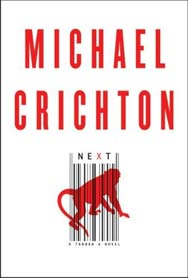
mcrichtonnext.jpg Next
Michael Crichton
ISBN: 978-0060872984

Pub. Date: November 28, 2006

Publisher: HarperCollins

I don’t know if I read Michael Crichton for education or entertainment.

As I scanned the paperback section of the airport bookstore, “Clever,” I thought. Michael Crichton’s book occupied not one, but three, shelf spaces. The book has three different covers: same design of a monkey and bar code, different background colors of red, green, or white. It worked. I bought a copy.

And this is a usual page turner. Gerald the parrot is the most alive and memorable character. Other are all superficially developed and stereotyped. Then again, you read a Michael Crichton for education and entertainment, not for literature.

He strongly criticized the genetic industry as greedy, anarchical, predatory, and confused. The main point is ownership of genes can people own genes like intellectual properties?

But I own my body and therefore all my genes, if genes can be owned. I then own half of my biological children’s genes too. Unless there was a mutation, they are simply copies of my genes. In fact, biological parents together own all of children’s genes.

Hold on. Grand-parents own parents’ genes, by the same logic. When they die, their properties, including the genes, are inherited by their offspring. Uncles and aunts therefore own all cousins’ genes together. If we pushed upward in the ancestry line, eventually, in legal sense, there is only one possible conclusion: the whole human population together owns the human genome.

This is fun then. If genes can be owned like properties, then genes must be owned by the entire human population, therefore genes cannot be owned by anyone. Without too much effort, one will reach the same conclusion for genes of any species.

No one owns life. How simple and blatantly obvious can that be?


我也不知道我读 Michael Crichton 的著作是为了学习还是为了娱乐。我在机场书店浏览平装书时,看到 Michael Crichton 的同一本书占据了三个书架的位置,就因为它有三种不同的封面:设计是相同的,都是一只猴子上覆盖着条形码,只是背景色分别为红色、绿色和白色。我不禁感叹道:此举真是聪明啊!还真有点儿作用。我就买了一本。这本书真无法释手。鹦鹉 Gerald 是其中最生动最令人印象深刻的角色。其他角色都不够深入所以难免落于俗套。再次重申,读 Michael Crichton 的书是为了学习和娱乐,不是文学鉴赏。他尖锐地批判了基因工业的几大问题:贪婪、无法、掠夺和混乱。最主要的是基因的所有权问题——人们能像拥有知识产权一样拥有基因吗?

但我的身体是我的,如果基因能被拥有的话,我身体理的基因也当然是我的了。既然如此,我亲生子女们的一半基因也是我的。因为除非发生突变,那一半是我的基因。实际上生父母共同拥有他们子女所有的基因。

等一下。依此类推,祖父母拥有父母的基因。他们去世后,他们的遗产,包括基因所有权,都会被他们的子孙继承。叔父和姨妈会因此拥有堂兄弟姐妹们的基因。如果我们通过家族血统向上追溯,最终,从法律的角度,我们只有一个结论:整个人类拥有整个人类的基因。

有趣吧。如果基因能像物品一样被拥有,那么基因的主人一定是全人类,而不是个人。不用多想,任何物种都是如此。

没有人能拥有生命。这难道不是不言自明的吗?

Posted in Books & Reviews | Tagged , | Leave a comment

Caligraphers at the Park

Walk into a park anytime on a good day, you find many active Beijingers. Starting at daybreak, exercising crowd group themselves by activities: folk dancers, martial arts, muscle trainers, Badmington, etc. Afternoon will have duelers attempt their kills on one of those cement ping-pong tables. Of course you will also find dog walkers, baby strollers, or simply people chit-chatting their hearts out loudly enough for you to join in. Evenings are for people dancing waltz, tango, swing, and cha-cha too.

That sunny day I walked into the famous BeiHai park. Live singing distracted my examination on historical relics. I searched the source and found a crowd gathered around this lady, in her early 60s. She had this portable amp on the ground and clicked on a microphone Modonna-style. She sang, danced, acted, and worked her audience. They rewarded her with applauses song after song. Wow, live street performance by true amateurs. What a sight.

Then I realized what I just stepped on.
caligrapher.jpg

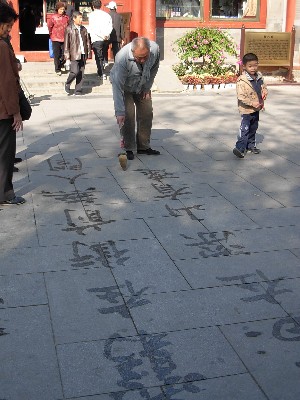
Several elderlies have been writing on the ground. Their grand-kids will take the long brush, run to a bucket nearby, soak it up with water, and run back to them. They will then write on the ground until the brush is dry. At that moment, a nod will send the grandkid happily for another dipping trip.

What a sight. These are just like side-walk chalk arts but will disappear in minutes. The artists enjoy doing a lot more than being appreciated by speculators. I walked up to the elderly artist, “Sir, these are very good works. You have been practicing long?” “No, just for about 15 years or so after I retired.” “I think they are very good. Why don’t you do it with ink and paper?” “No, no. These are not good enough to waste paper and ink yet. Beside, this is good exercise for me. Good for my Qi.”

He went on writing. I watched and felt his Qi.

Posted in Tour guides | Leave a comment