
Spitting, Queue-jumping, Swearing and Smoking

What constitute civilization? What makes a society pleasant to be part of, or intolerable? What makes you shake your heads, or irate and want to punch someone? What make you thinking of not coming back to this area ever?

Small things. What Rudy Giuliani called “quality of life” factors. In China, they fall into two general categories: inconsideration to others and not picking up after self. These are the new “4 pests” China government want to eradicate before Olympics. And I am 100% behind it. I would like to add the 5th one (and everyone has their favorite 5th one too) of littering.

I am confident that China will become a pleasant place for everyone. The economy is driving it and nothing motivates a Chinese more than growth. As the economy turns more and more consumer oriented, those “one time get rich schemes” will disappear and reputation will prevail as the leading success factor. At business level, this means quality and services. At personal level, this means good social behaviors. I also believe, in general, individual wealth promotes nicer social protocols.

It will be a nice day for me to see someone walking 5 paces, clear his or her phelgm into a tissue, and throw that into a garbage can.

Posted in China | Leave a comment

Letter from China: What if Beijing is right?

A Howard W. French questioned, on International Herald of Tribute on November 2nd, 2007, if the deeply rooted American values of democracy and check-and-balance are really superior. What if Beijing is right?

I have long explained to people that China’s current governance model has existed for over 2200 years. The system experienced ups and downs over these centuries and had a bad phase from mid-1800s to early 1900s. Before that, it was the most powerful and prosperous country in the world.

Jared Diamond, in Guns, Germs, and Steel, tried this China puzzle with a geographic slice. He observed that, culturally and geographically, China is homogeneous and uniform, as contrast with Europe be heterogeneous and diversified. What’s most interesting to me is America’s entrance to this great social experiment few hundred years ago. In a few centuries, would some comparative governmental historians make a conclusion?

A centralized, non-elective government can make fair, but not just, decisions, faster. It can sacrifice few for many — economically right decisions but sometime not humane. To avoid debilitating corruptions, China has a power transfer scheme that has worked quite well for the past 30 years.

Are democracy and freedom-of-speech good for all civilizations all the time? Americans viewed this very question as religiously condemnable. You can hardly blame them. Their mere few hundreds years of experience had hardly been tested by any serious challenges: except for now.

Posted in Witness to my life | Leave a comment

Duck Blood Rice Noodle Soup

The Confucius Temple (夫子庙) area reminds me of ShangHai’s City God’s Temple (城隍庙). It stands, non-participatorily aloof amidst the touristic crowd, on the banks of QinHuai river (秦淮河): the entertainment center of the capital for hundreds of years. This area is known for great foods, hedonistic music and dances, drunken social elites, and, of course, beauties who sank rich into rags. Confucius would hardly approve.

The long queues at the stinky tofu (臭豆腐) stand got me curious. I have always been a big fan of stinky tofu and naturally cannot resist. Well, they are not that, eh, aromatic. But fried to perfection: crispy on the outside, tender and piping hot inside. I had two orders.

Every corners has a big sign saying they have the best duck blood rice noodle soup (鸭血粉丝汤). I hestitated and eventually dared one. I can see it as a comfort food for local, but not something for tourists to remember the trip for.

ZhongShan area (钟山风景区) is a must-go. Ming Xiao Ling (明孝陵) buries the founding emperor of Ming dynasty, the last dynasty by Han people. Zhong Shan Ling (中山陵) is the tomb of Dr. SUN Yet-Sat: the one who ended China’s monarchy. There is also LingGu Temple (灵谷寺) that has a very interesting, and rare, brick building. In additonal to historical signficance, these are among the finest monumentary archtectural designs. I found Parasol trees (梧桐) romantically autumn; acres of Osmanthus (桂花) gave a pleasant sweet aroma — a surprise.

NanJing feels calmer than Beijing that has been caught in the renovation and modernization frenzy. People here seem to long for the ShangHai-style glory and growth. I found them lovely and friendly, foods very agreeable, and rivers attractively charming. The city’s history also gives it the cultural depth.

Maybe the economy is not everything a city needs?

Posted in Tour guides | 1 Comment

A Capitol Hill Theater

Jammie Thomas was devastated by RIAA by making copyrighted songs available for others to download. They traced her via an IP address. Her service provider betrayed her by linking the IP address with her real identity and provided this link to RIAA.

Seatle Times PhotoYahoo betrayed Shi Tao and devastated him no less drastically than Ms. Thomas. Like Ms. Thomas’s service provider, Yahoo did so in compliance to the laws. Only that Yahoo complied to China law, instead of US. For that, Jerry Yang, CEO of Yahoo, received tongue-lashing from Congressman Tom Lantos as a “moral pigmy.”
Companies violated US laws all the time: minimum wages, maximum working hours, accounting principles, environmental protection, working conditions (OSHA regulations), etc. It is OK to do so outside of US soil and be in compliance with laws. Yahoo did not even violate any US law, only a value system and an ideology. This theater, therefore, is to send a message to China government, “We don’t like how you govern.”

Jerry Yang and Li Tao’s family are merely political props.

Posted in Witness to my life | Leave a comment

Sleep, the new diet program

I endured years of protest imposing strict sleeping routine for my kids. They must be in bed and light-out earlier than most of their friends, at least so they claim.

A recent study showed a good night's sleep, when the kid is young, will help their grades, make them more socialable, and even avoid later time over-weight.

I guess this makes sense. A good night's sleep give them more energy, to focus in class, and more participatory on the playground — that becomes higher interest in activities and exercises later.

Posted in Books & Reviews | Leave a comment

They are 16 years old!

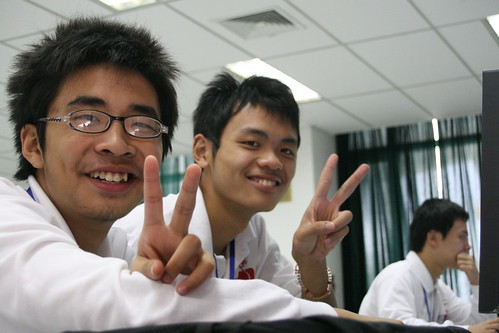
If you read Jim Grisanzio's blog like many, you have already known about our ACM/ICPC contest in Nanjing and seen this picture.

They are high-school kids! These two are 17 and their teammates are even younger. They, about 10 high-schoolers, are guests in this college-only event. They would go through the contest like real teams, but won't be eligible for winnning.

I chatted with them briefly. They have only heard about Solaris prior to this contest. “It seems very powerful. Everything that is supposed to work really does.” Jim had a conversation with them too — in English. They are not shy, they know they probably won't win, but they knew the future will be theirs.

And I am real glad that they learned Solaris already.

Posted in China | Leave a comment

History Lessons

Qing Dynasty's 12 Emperors (New with Full-Color Illustrations)

YAN ChongNian


ISBN: 710105062X

Pub. Date: 2006-4-1

Publisher: 中华书局

Only Han, Tang, Ming and Qing dynasties survived more than 200 years in China history. Qing is the last one and also the only one whose rulers were not of the Han race. Every Chinese people shakes head and sighs when they read the recent history. Why! Is it the monarchy governance? Is it Cixi (慈禧) to be blamed? Was it God's will? If I were Qian Long (乾隆), would China have risen to its place as a major global player 300 years ago? At the very least we would have avoided the multi-nation invasion and the Opium Wars. After the Tong Zhi period, the demise of the Qing Dynasty became just a matter of time. The government botched one opportunity after another. It has been 210 years since Qian Long descended from the throne in 1796 and left behind the most prosperous time. If we think about these last 200 years Chinese people have to sigh again.

YI ZhongTian's (易中天) commentary on the era of the Three Kingdoms (品味三国) has inspired the public to take an interest in popular history. YAN ChongNian (阎崇年) further demythified history for the mass. They both came to fame as media personalities before they published: re-printed again, then new edition, then newer with illustrations, then with color illustrations – the contents are mostly the same but the price is not. Those who bought the book early on might begin to feel buyer's remorse. But the whole book (TV versions) can be downloaded free of charge. Interesting business model.

Although the Qing Dynasty had such a long history it had no more than twelve emperors. The reign of Nurhaci (努儿哈赤) and Hung Taiji (皇太极) didn't really count. Guang Xu (光绪) and Xuan Tong (宣统) were useless. The prosperity of the early era was followed by the Jia Qing (嘉庆), Dao Guang (道光), Xian Feng (咸丰) and Tong Zhi (同治). Those 4 did away the great Qing Dynasty in 80 short years.

Make you think.

Posted in Books & Reviews | Leave a comment

College kids

Guess which school my kid is in?

Posted in Peek into my mind | Leave a comment

Drums of War Started at YuYang

It's national holiday for the whole week. My plan was simple: sleep. I have crossed pacific too many times this year. I need to get to know my bed better. For the 1st two day, it worked. I will doze off few times during the day. I can feel the sleep deficit being paid back. I really needed this holiday.

Qing Tombs

When a friend called for a day-trip to the Qing tombs, I was just about to get bored. I jumped on it immediately and was quite glad that I did. Qing's emperors chose to have their tombs about 150 kilometers east of Beijing. (Ming's emperors picked a site north of Beijing along the route to a famous Great Wall spot.) The trip organizer decided to visit a buddasm temple, DuLe temple (独乐寺) on our way. It was a great choice. DuLe temple is a thousand-year old historical site and an active temple. We studied the architecture and marvelled at the artifacts.
The temple is at Ji county in TianJin City (天津市,蓟县: There is no mistake here. TianJin city has a Province level status.) As we walked around the town, we realized that Ji county used to be called YuYang (渔阳) few hundred years ago.
Waves of memory swept over me and I was thrown back to teenage years. This is the city I dreamt about so many times. Cool, cool, cool!

About 1300 years ago, Tang (唐) dynasty ruled the middle kingdom. It was glorious time. But warlord AnLuShan (安禄山: 703~757) wanted more. He started his coup right here from this city of YuYang. When he was stationed here, he read a line from Confucius that the happiness of many is better than one and named the temple accordingly. The literal interpretation would be “The Temple of Solitary Happiness.” The general interpretation is that he would rather not share.

Few decades later, poet BAI JuYi (白居易) wrote a long poem about a beautiful girl, the emperor, and Mr. AnLuShan. Every generation re-read the poem and all got enchanted by the sadness and the intensity of the story.

Time warped to 1930s, musician HUANG Zi (黄自) captured the story and turned it into a master-piece choir. My high-school class, in my junior year, picked it to enter a choir competition. We practiced hard, won at school level, entered a tournament, and won again. That was many months of intense practice, focus, camaraderie, and hardwork. It was one of the best times of my life.

Posted in Tour guides | Leave a comment

My Wine Education

I grew up knowing few forms of alcoholic drinks: hard liquor (BaiJiu: 白酒), milder rice wines (HuangJiu: 黄酒), and beer. Honestly, the idea is getting others drunk and staying sober at the same time. Social cohesion and the capacity to hold liquor are more important skills than the ability to distinguish the finer flavors of the drinks.

Much older, I met Kathy and a group of wine fanatics. They taught me this new alcoholic drink called grape wines. (And yet many years later, Crawford taught me whiskey.)
I learned how to swirl, hold the glass to the light, sniff, sip, and make some comments. Those who really know me will snicker, “Sin-Yaw has no taste buds on wines.” They will be right and we all knew it does not matter. The real important skill is not to be able to tell the difference between a $15 bottle and a $20 one, but to appreciate the drink and enjoy the company or the foods. As Rich said, “The lubricant of conversation.”

Recently, I found out that a few people in China are at the same stage I was many years ago. “This is cool,” I thought. “How about wine tasting in China?”

As far as I have observed Kathy’s parties, this is how:

  1. Decide a theme: First choose a theme for the tasting. This is usually arbitrary and up to the host. The typical theme surround grape varietal or region: Shiraz, Cabernet, Southern Italian, etc. At the same time, choose a price guideline for the participants.
  2. Infra-structure: Wine-tasting parties need many glasses, a spit bucket, a clean water source to rinse the glasses, and a stain-resistant surface.

    Glasses should be transparent and easy to swirl. They don’t need to be expensive. Spit bucket is for throwing away wines: a normal and perfectly OK thing to do. Some people intend to taste many wines and do not wish to get drunk. Others simply do not like the wine enough to finish the glass. Water is for rinsing the glasses. Some people prefer to rinse the glass before trying a new wine. Lastly, wine pouring can be nasty on delicate surfaces.

  3. Foods: Foods serve to cleanse the palate. In between wines, it is necessary to remove the tastes of the previous wines from your mouth. Eating simple, non-spicy and not too salty foods are best. Crackers, french bread, and simple cheeses are popular choices.

    Coffee, either ground or beans, is the best olfactory cleanser. Sniff the coffee in between wines to restore fresh scent.

  4. Wines: The host should secure enough variety and quantity for the participants. Average person can consume about half a bottle without too much trouble. Each “serving” should be about a quarter glass or even less. The point is to taste wines and not drink them.

    The host should make sure the drivers are sober before leaving. This means at least an hour without taking any alcohol before driving.

    Of course the focus of the party is to talk about the wines just tasted. Some kinds of note taking devices will enhance everyone’s knowledge and memory.

Internet offers wealth of information on this subject. I read the quick online wine-tasting course and went to UC Davis site for its tasting wheel too.

Now I am ready to be invited.

Posted in Witness to my life | 1 Comment